In this article
- Who can donate
- The tests, in order
- How much liver is taken
- The risks, honestly
- The operation and the scar
- Recovery timeline
- Life after donation
- The law protects the donor
- How to decide
Who can donate
A near relative — spouse, parent, child, sibling, grandparent or grandchild — aged 18 to about 55, with a compatible blood group (identical or O), a body mass index under roughly 30, no diabetes, hepatitis B or C, heart or lung disease, and a liver whose size and anatomy on CT and MRI allow a safe split. Fatty liver is the commonest reason a willing donor is turned down; a few weeks of diet and exercise sometimes fixes it.
The tests, in order
Blood group and basic bloods first — no point going further if these fail. Then liver function, viral markers and a full medical check. Then imaging: a CT scan with volumetry calculates the volume of the right lobe to be donated and the volume that will remain (it must be at least 30–35% of the donor's total), and maps the arteries and veins; an MRCP maps the bile ducts. Finally, fitness tests (echocardiography, lung function), a psychological assessment, and — if the liver looks fatty on imaging — sometimes a small liver biopsy.
How much liver is taken
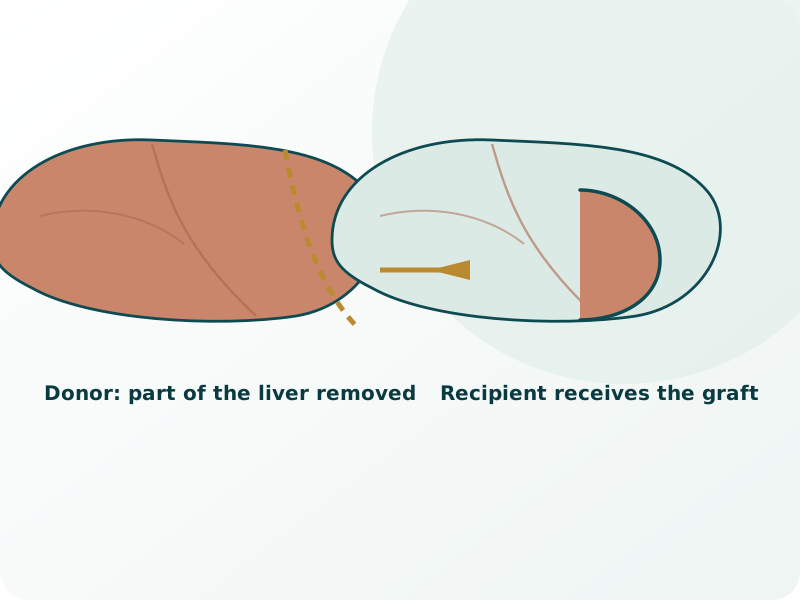
For an adult recipient, the right lobe: about 55–65% of the donor's liver. For a small child, the left lateral segment: about 20–25%. The donor's remaining liver begins regenerating within days and reaches close to its original volume within six to eight weeks. Liver function tests are back to normal well before that.
The risks, honestly
Donor hepatectomy is major surgery. Worldwide data from high-volume programmes show that around a fifth to a third of donors have some complication, most of them minor and temporary — a bile leak that settles with a drain, a wound infection, a chest infection. Serious complications are uncommon, and donor death, though it has occurred, is rare — estimated at about 1 in 500 or less for right lobe donation in experienced hands. These figures are why donation should only happen at a high-volume centre and why donors are selected so strictly.
The operation and the scar
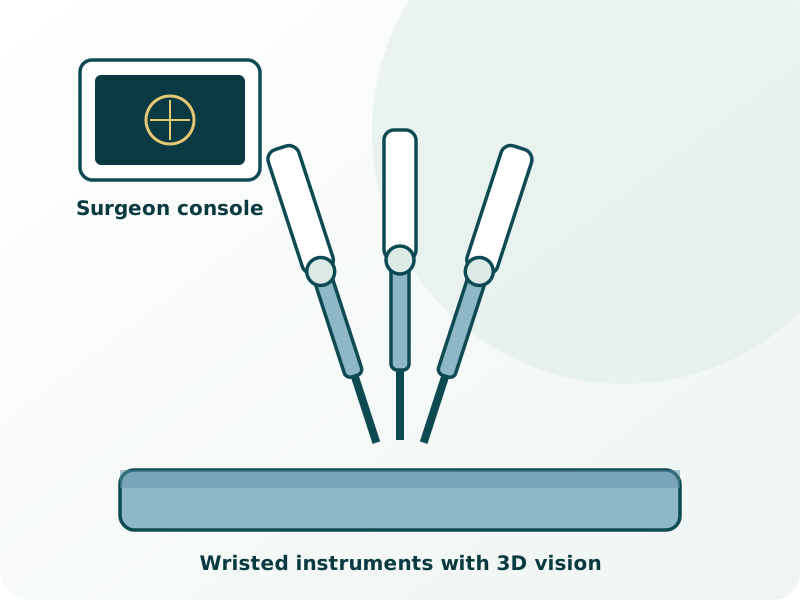
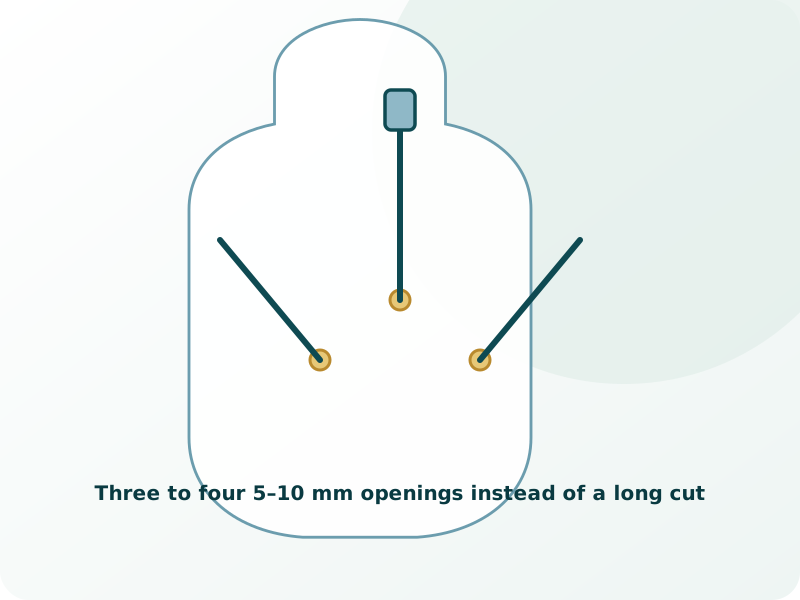
The traditional donor operation uses an incision under the right ribs. In suitable donors, Dr Gupta's team performs the donor hepatectomy laparoscopically or robotically, with a small lower incision to remove the lobe — less pain, a faster return to activity and a much smaller scar. The choice depends on the donor's anatomy and the size of the lobe.
Recovery timeline
ICU for a day, ward for four to six days, walking from day one, eating from day two. Home within a week. Light activity in two weeks, desk work in three to four, full activity including gym and lifting in six to eight. Follow-up blood tests at one, three and six months and then yearly.
Life after donation
No medicines, no diet restrictions once recovered, no effect on future pregnancy, and — in every long-term study — normal life expectancy. Donors can have surgery later in life on the remaining liver if ever needed, because it has regrown.
The law protects the donor
Under the Transplantation of Human Organs and Tissues Act, an authorisation committee interviews the donor separately from the family to confirm that consent is free and that no money is involved. Dr Gupta also meets every donor alone. A donor can withdraw at any point, including on the morning of surgery, and no reason is required — the family is simply told the donor was found unsuitable.
How to decide
Donate because you want to, not because you are the only match. Ask to speak to a previous donor — the programme will arrange it. Ask about the centre's donor complication rate. And ask every question you have; a donor who understands the operation recovers better than one who was afraid to ask.
Sources
- Abecassis MM, et al. Complications of living donor hepatic lobectomy — a comprehensive report (A2ALL). Am J Transplant 2012;12:1208–1217.
- Cheah YL, et al. Incidence of death and potentially life-threatening near-miss events in living donor hepatic lobectomy: a world-wide survey. Liver Transpl 2013;19:499–506.
- Transplantation of Human Organs and Tissues Act, 1994 and Rules, 2014 — Government of India.

Dr Manoj Gupta
MBBS, MS, DNB (GI Surgery). Senior Director & Head, Robotic & Laparoscopic GI Surgery, GI Oncology and Liver Transplant, Yatharth Super Speciality Hospital. 20+ years, 500+ liver transplants.
This article is general medical education and does not replace a consultation. Figures quoted are from the sources listed and from typical outcomes at experienced centres; your own numbers depend on your condition.