In this article
- Who actually needs a liver transplant
- Living donor or deceased donor?
- The evaluation: what the two weeks involve
- The operation
- Recovery: ICU, ward, home
- Results you should ask any centre about
- What decides the cost
- When to ask for a transplant opinion
Who actually needs a liver transplant
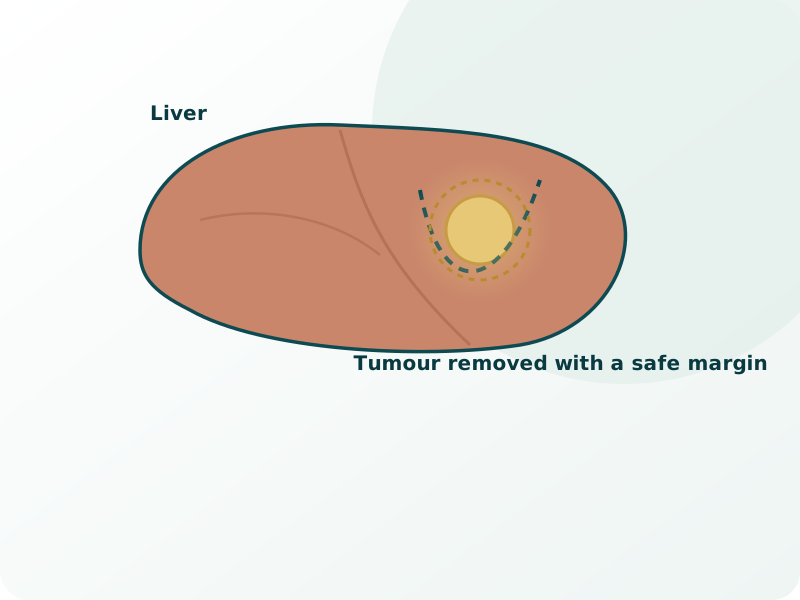
Not everyone with cirrhosis needs a transplant. A scarred liver can work for years if it is 'compensated' — no fluid, no bleeding, no confusion. Transplant becomes the right treatment when the liver decompensates: ascites that keeps returning, bleeding from varices, hepatic encephalopathy, or a MELD score (a formula using bilirubin, creatinine and INR) of about 15 or more. Two other groups need it: patients with acute liver failure, where the liver stops working within days after hepatitis or a drug reaction, and patients with liver cancer (hepatocellular carcinoma) within the Milan or UCSF criteria, where transplant removes both the tumour and the cirrhotic liver that produced it. In children, biliary atresia is the commonest reason.
Living donor or deceased donor?
In India, roughly nine out of ten liver transplants use a living donor — a healthy near relative who gives the right lobe of their liver (about 60% of the organ) to an adult recipient, or a smaller left segment to a child. The donor's liver regrows to full size within six to eight weeks. Deceased donor livers are allotted through NOTTO and the state registries, but waiting times are long and unpredictable. A living donor transplant can be planned for a date when the patient is as fit as possible — a decisive advantage.
The evaluation: what the two weeks involve
The recipient's work-up checks whether the rest of the body can withstand a 10-hour operation and lifelong immunosuppression: blood and viral tests, a triple-phase CT or MRI of the liver, echocardiography and often a stress test, lung function tests, dental review, infection screening, nutrition assessment and a psychiatric evaluation. The donor's work-up runs in parallel: blood group, liver tests, a CT volumetry to calculate exactly how much liver can be taken while leaving the donor at least 30–35% of their own, an MRCP of the bile ducts, and fitness tests. Finally, the hospital's authorisation committee verifies the relationship and the donor's free consent, as required by the Transplantation of Human Organs and Tissues Act.
The operation
Donor and recipient are operated in parallel theatres. The donor's right lobe is removed — laparoscopically or robotically in suitable donors — with its artery, portal vein, hepatic vein and bile duct preserved. In the recipient's theatre, the diseased liver is removed and the graft is implanted: hepatic vein, portal vein, hepatic artery and bile duct are joined in turn, the artery under a microscope or high magnification. The whole process takes 8–12 hours, and the new liver usually starts producing bile before the abdomen is closed.
Recovery: ICU, ward, home
The recipient spends about a week in a dedicated liver ICU: Doppler ultrasound checks blood flow into the graft, blood tests every few hours track liver function, and immunosuppressants (tacrolimus, mycophenolate and a short course of steroids) are started and their levels adjusted. Walking begins on day two or three, eating shortly after. The donor usually goes home within a week; the recipient in two to three weeks. Return to work: donor at four to six weeks, recipient at about three months.
Results you should ask any centre about
At experienced Indian centres, one-year survival after elective living donor liver transplant is around 90%, with five-year survival of 70–80%. The numbers are worse for very sick patients transplanted late, and for acute liver failure — which is why timing matters. Ask any programme two questions: how many transplants it does each year, and what its own one-year survival is.
What decides the cost
The largest variables are the patient's condition on admission (a patient with a MELD of 30 needs more ICU days than one with a MELD of 16), the room category, blood products, and whether complications occur. Donor surgery, the operation itself, the standard ICU and ward stay, and routine medicines are included in most hospital packages. After discharge, immunosuppressant tablets become a monthly expense that falls as doses are reduced over the first year. Many health insurance policies, corporate schemes and CGHS/ECHS cover transplant with pre-authorisation; the hospital's insurance desk handles this.
When to ask for a transplant opinion
Early. The commonest regret in transplant clinics is the year spent between the first episode of decompensation and the first transplant consultation — a year in which the patient became weaker and the operation riskier. If you or a relative has cirrhosis with ascites, bleeding, confusion or a rising MELD, bring the reports — a transplant opinion does not commit you to a transplant, but it tells you where you stand.
Sources
- Mazzaferro V, et al. Liver transplantation for the treatment of small hepatocellular carcinomas in patients with cirrhosis. N Engl J Med 1996;334:693–699.
- Yao FY, et al. Liver transplantation for hepatocellular carcinoma: expansion of the tumor size limits does not adversely impact survival. Hepatology 2001;33:1394–1403.
- Transplantation of Human Organs and Tissues Act, 1994 (as amended 2011) and Rules, 2014 — Government of India.
- National Organ and Tissue Transplant Organisation (NOTTO), Ministry of Health & Family Welfare, Government of India.

Dr Manoj Gupta
MBBS, MS, DNB (GI Surgery). Senior Director & Head, Robotic & Laparoscopic GI Surgery, GI Oncology and Liver Transplant, Yatharth Super Speciality Hospital. 20+ years, 500+ liver transplants.
This article is general medical education and does not replace a consultation. Figures quoted are from the sources listed and from typical outcomes at experienced centres; your own numbers depend on your condition.